
Showing posts with label Greece. Show all posts
Showing posts with label Greece. Show all posts
Thursday, October 16, 2014
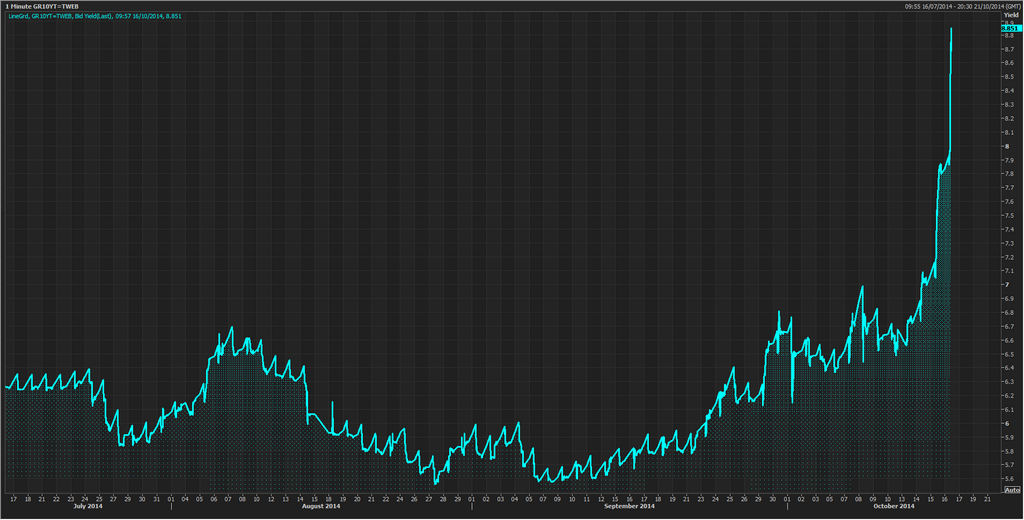
This Week in Greek Interest Rates (Ugly)
Greek interest rates are up more than 200 basis points this week to 8.85%, as fears mount that the Greek government will have trouble re-financing its debt at rates that can be sustained. Are we headed for a Greek Crisis II, with the possibility that the banksters will get clipped this time?

Wednesday, October 15, 2014
Greece Again: Bonds Collapsing
Greece’s 10-year bonds fell for a third straight day, pushing the yield up by the most in more than two years. Overnight, Greece’s 10-year yield increased 81 basis points, or 0.81 percentage point, to 7.81 percent.
Fears are that the government will not be able to raise enough new money at reasonable interest rates to payoff debt coming due. The fears come as a result of the government’s plans to hold onto power by ending an international bailout that will result in the nation moving away from austerity plans imposed by international bankers.
Greek bank stocks plunged in reaction:
NBG -13%
Piraeus -14%
Alpha -14%
Eurobank -20%
Fears are that the government will not be able to raise enough new money at reasonable interest rates to payoff debt coming due. The fears come as a result of the government’s plans to hold onto power by ending an international bailout that will result in the nation moving away from austerity plans imposed by international bankers.
Greek bank stocks plunged in reaction:
NBG -13%
Piraeus -14%
Alpha -14%
Eurobank -20%
Monday, December 5, 2011
Biden Jokes about US Bailout while in Greece
Vice President Joe Biden joked Monday during a visit to Greece about bringing U.S. money to lift the struggling nation out of a financial crisis, Viki Needham at The Hill reports.
During a trip to Athens, Biden introduced a U.S. Treasury official during a meeting with Greek President Karolos Papoulias, saying "this man represents the Treasury department. He's brought hundreds of millions of dollars."
Everyone laughed, according to Needham. Just a joke among cronies.
Of course, the real money man and enforcer, Treasury Secretary Tim Geithner, arrives in Europe tomorrow.
During a trip to Athens, Biden introduced a U.S. Treasury official during a meeting with Greek President Karolos Papoulias, saying "this man represents the Treasury department. He's brought hundreds of millions of dollars."
Everyone laughed, according to Needham. Just a joke among cronies.
Of course, the real money man and enforcer, Treasury Secretary Tim Geithner, arrives in Europe tomorrow.
Wednesday, November 30, 2011
Interventionist Policies and Youth Employment Don't Mix
50% of workers under 25 are unemployed in Spain and Greece. It's a combination of high minimum wage laws, the nanny state and regulations keeping youth from getting jobs---a truly sad situation.


Tuesday, September 14, 2010
College Graduates Bailing Out of Greece (The Collapse of Interventionism-Greek Edition)
Cuba is firing 500,000 government employees and allowing the private sector to deal with them. And now the super-interventionist Greece is experiencing a brain drain
According to a survey published last month, 7 out of 10 Greek college graduates want to work abroad. Four in 10 are actively seeking jobs abroad or are pursuing further education to gain a foothold in the foreign job market. The survey, conducted by the polling firm Kapa Research for To Vima, a center-left newspaper, questioned 5,442 Greeks between the ages of 22 and 35.
Ludwig von Mises was absolutely correct interventionism can not succeed. Interventionism is the new Fail.
According to a survey published last month, 7 out of 10 Greek college graduates want to work abroad. Four in 10 are actively seeking jobs abroad or are pursuing further education to gain a foothold in the foreign job market. The survey, conducted by the polling firm Kapa Research for To Vima, a center-left newspaper, questioned 5,442 Greeks between the ages of 22 and 35.
Ludwig von Mises was absolutely correct interventionism can not succeed. Interventionism is the new Fail.
Wednesday, September 8, 2010
Greece, Again
It’s not just the Greek banks that have been spooked by National Bank of Greece’s cash call and attendant fears of government debt restructuring, reports FT.
French banks Société Générale and Credit Agricole, which have large holdings of Greek government debt and/or Greek banking businesses, are under pressure on Wednesday morning.
Nouriel Roubini, correctly, continues to call for an orderly Greek debt restructuring:
French banks Société Générale and Credit Agricole, which have large holdings of Greek government debt and/or Greek banking businesses, are under pressure on Wednesday morning.
Nouriel Roubini, correctly, continues to call for an orderly Greek debt restructuring:
It is time to recognize that Greece is not suffering only from a liquidity crisis — it is also facing an insolvency crisis — thus an orderly restructuring of Greece’s public debt, rather than an EU/IMF bailout that only delays such restructuring and risk making it disorderly, is the appropriate policy response now.
Wednesday, June 16, 2010
If You Were a Greek Rich Guy, What Should You Be Doing?
John Hempton fills us in:
There really is only one big problem with National Bank of Greece – and that is Greece. Lurking in the balance sheet you will see about 20 billion euro of “due-to-banks”. This is interbank funding due to other European banks (presumably German). Offsetting this is about 16 billion in investment securities. Note 22 covers those – and they are mostly Greek Government Bonds – and if they not “Hellenics” then they are credit conditional the Greek Government anyway…
Take the investment securities away – and throw in the deep recession that is likely if the Government defaults – and it is pretty hard to see how NBG gets out of this.
The last quarterly conference call was one of the saddest things I have ever listened to – because the management seemed – certainly by the standard of regional bankers – to be a very fine group of individuals. They ran a darn tight ship – a bank that should be OK and indeed I quite like. Certainly NBG is one of the better run banks out there. Most of the conference call was about running day-to-day banking and how you operate in what is a very tough environment. [The tough environment] of course was the one credit that they could not “manage” – the local Sovereign. And the management stated that they were “the best credit in town”. This line is a paragon of wishful thinking.
Alas if Greece defaults it looks likely that NBG goes with it – as would any other Greek bank (except probably Emporiki where the losses will be borne by Credit Agricole)...
If you were a Greek rich guy with substantial deposits what would you be doing? Short answer: run at par. You can get out at par something that is ultimately credit risk Greek Government without any penalty.
Deposits are falling in Greece. Not a lot – but the fall in the first quarter results was just under 2 billion euro. This is not seasonal… Rich Greek guys of course know about capital flight (they have done that before) but they are only doing it a little – indeed it surprises me that there are not violent runs happening... [contra possibility: the rich guys were never in Greek banks at all…]
NBG is a good bank. But if the Sovereign defaults, it is in deep trouble. Sovereign default will mean that NBG cannot pay back its interbank obligations. None of this should be a surprise to anyone watching the stock price. NBG has not been a good stock. The German banks will lose not only on their holdings of Greek sovereign securities but on their NBG inter-bank funding as well.
Monday, June 14, 2010
Moody's Cuts Greece Government Ratings to Junk
Moody's has downgraded Greece government bond ratings into junk territory,
They cut the rating four notches to Ba1, placing it one notch into junk status.
The IMF/eurozone rescue package "effectively eliminates any near-term risk of a liquidity-driven default and encourages the implementation of a credible, feasible, and incentive-compatible set of structural reforms, which have a high likelihood of stabilizing debt service requirements at manageable levels," said Moody's senior analyst Sarah Carlson.
They cut the rating four notches to Ba1, placing it one notch into junk status.
The IMF/eurozone rescue package "effectively eliminates any near-term risk of a liquidity-driven default and encourages the implementation of a credible, feasible, and incentive-compatible set of structural reforms, which have a high likelihood of stabilizing debt service requirements at manageable levels," said Moody's senior analyst Sarah Carlson.
"Nevertheless, the macroeconomic and implementation risks associated with the program are substantial and more consistent with a Ba1 rating," Carlson added.
Monday, June 7, 2010
Morgan Stanley: Greece Will Go Under This Year, Fears for U.S.
There is no quick fix to the European debt crisis, and Greece will be forced to restructure its debt later this year, said Greg Peters, global head of fixed income and economic research with Morgan Stanley on Monday.
Spain is the linchpin of European sovereign debt markets that have recently come under pressure and Peters' biggest worry, he said. He also said he is concerned about France. Ultimately, he is most concerned about a European crisis spreading to Britain and possibly the United States.
"The key concern I have is the contagion risk around the sovereign debt crisis," he said at the Reuters Investment Outlook Summit in New York.
"Really, what I worry about most is the sovereign debt crisis becoming a rolling crisis and hitting the shores of the U.K and the United States."
Spain is the linchpin of European sovereign debt markets that have recently come under pressure and Peters' biggest worry, he said. He also said he is concerned about France. Ultimately, he is most concerned about a European crisis spreading to Britain and possibly the United States.
"The key concern I have is the contagion risk around the sovereign debt crisis," he said at the Reuters Investment Outlook Summit in New York.
"Really, what I worry about most is the sovereign debt crisis becoming a rolling crisis and hitting the shores of the U.K and the United States."
Friday, May 28, 2010
It's the Bailout of the Banksters Before Greece Is Taken Down
WSJ has a remarkably to the point story explainning why Greece will end up restructuring, but that there will be a delay until the banksters are protected:
Even as investors grapple with the short-term economic impact of the European debt crisis, an important longer-term issue lingers in the background—the likelihood that Greece will have to restructure its debt...
While a restructuring may not take place for another year or two, it's a move that Greece may be unable to avoid, many say, despite assurances to the contrary from officials at the EU and IMF.
Restructuring is essentially a default, under which Greece would renegotiate its debt with bondholders, either lengthening its maturities or reducing the amount it owes, causing bondholders to take a loss...
The EU and IMF's bailout plan, which involves €80 billion ($99 billion) in loans from the 15 other euro-zone countries and 30 billion from the IMF, is designed to keep Greece afloat for a few years while the country enacts giant cuts and fiscal reforms...
One reason a near-term restructuring isn't likely, analysts say, is that much of Greece's debt remains in the hands of European banks and a restructuring could inflict sizable losses.
But because the European Central Bank has been aggressively buying up government debt, Greece will eventually have fewer private debtholders to persuade, making a later restructuring easier to engineer.
The basic problem is that even with aggressive fiscal belt tightening, the outlook for the Greek budget deficit is grim.
The Greek government had €273.4 billion in debt at the end of last year, equivalent to 115.1% of the country's gross domestic product. That ratio will rise sharply through 2012 toward 150% of GDP, since a yawning budget gap adds more to the tab each year. There are few signs that the stagnant Greek economy will grow anywhere near fast enough to catch up.
Saturday, May 22, 2010
This Will Not Go Down Well with the PIIGS
European Union finance ministers pledged to stiffen sanctions on high-deficit countries and ruled out setting up a mechanism to manage state defaults, saying no euro country will be allowed to renege on its debts, reports Bloomberg.
“We will provide new sanctions, more than is now provided,” EU President Herman Van Rompuy said after the four- hour brainstorming session in Brussels yesterday. “Everyone is ready to go ahead with a strong stability and growth pact.”
Like the rest of the plans this won't work. The PIIGS citizens see these sanctions, correctly, as the banksters squeezing the life blood out of them.
What really needs to occur is the exact opposite. Those countries that can't pay their bills need to go into bankruptcy. Each country should also revert back to their own currencies and each should manage their own affiars. The great one world unions are a failure. The patch jobs will only delay the inevitable collapse and make it worse.
“We will provide new sanctions, more than is now provided,” EU President Herman Van Rompuy said after the four- hour brainstorming session in Brussels yesterday. “Everyone is ready to go ahead with a strong stability and growth pact.”
Like the rest of the plans this won't work. The PIIGS citizens see these sanctions, correctly, as the banksters squeezing the life blood out of them.
What really needs to occur is the exact opposite. Those countries that can't pay their bills need to go into bankruptcy. Each country should also revert back to their own currencies and each should manage their own affiars. The great one world unions are a failure. The patch jobs will only delay the inevitable collapse and make it worse.
Tuesday, May 18, 2010
Greece Finance Ministry Confirms Has Received 1st Aid Tranche
The banksters can breathe easy.
Greece confirmed Tuesday that it has received its first tranche of aid from fellow Eurozone states, totaling E14.5 billion.
The payment was received from the European Commission through the European Central Bank.
In an e-mailed statement, the Ministry of Finance said: “Today’s release together with the amount of E5.5 billion disbursed on May 12 by the International Monetary Fund covers the first tranche of E20 billion
in the support mechanism totaling E110 billion for Greece agreed with Eurozone and the IMF under the three-year economic and financial policy program.”
“These disbursements cover the immediate and short-term financing needs of the Hellenic Republic”, added the press release.
The E110 billion program is separate from the E750 billion package
agreed on May 9 by the Eurozone, EU and IMF.
The Eurozone aid included in the first tranche breaks down as
follows, the Greek Finance Ministry said:
Eurozone country Amount (in Euros)
Germany 4,427,870,552.22
France 3,325,164,236.57
Italy 2,921,922,720.93
Spain 1,941,619,822.00
The Netherlands 932,510,618.54
Austria 454,003,276.67
Portugal 409,274,004.99
Luxembourg 40,847,902.58
Cyprus 32,009,604.25
Malta 14,777,260.69
TOTAL 14,500,000,000.00
(ViaMarketNews)
Greece confirmed Tuesday that it has received its first tranche of aid from fellow Eurozone states, totaling E14.5 billion.
The payment was received from the European Commission through the European Central Bank.
In an e-mailed statement, the Ministry of Finance said: “Today’s release together with the amount of E5.5 billion disbursed on May 12 by the International Monetary Fund covers the first tranche of E20 billion
in the support mechanism totaling E110 billion for Greece agreed with Eurozone and the IMF under the three-year economic and financial policy program.”
“These disbursements cover the immediate and short-term financing needs of the Hellenic Republic”, added the press release.
The E110 billion program is separate from the E750 billion package
agreed on May 9 by the Eurozone, EU and IMF.
The Eurozone aid included in the first tranche breaks down as
follows, the Greek Finance Ministry said:
Eurozone country Amount (in Euros)
Germany 4,427,870,552.22
France 3,325,164,236.57
Italy 2,921,922,720.93
Spain 1,941,619,822.00
The Netherlands 932,510,618.54
Austria 454,003,276.67
Portugal 409,274,004.99
Luxembourg 40,847,902.58
Cyprus 32,009,604.25
Malta 14,777,260.69
TOTAL 14,500,000,000.00
(ViaMarketNews)
Thursday, May 13, 2010
The Kaleidoscope Has Turned, Again
The business scene and its participants can be looked on as a staging contest of rival orientations, rival ambitions, rival exploitations of the world. It is capable, for all the analyst can tell ex ante facto, of realizing some one or other of these visions in some degree, and thus of presenting an appearance of momentary or temporary orderliness during the ascendancy of one orientation and its sponsors. Or the contest may be inconclusive and sterile, and result in a period of rudderless backing and filling of the sails and of untidy, blind struggle and groping for decisive policy.It will be a kaleidic society,interspersing its moments or intervals of order assurance and beauty with sudden disintegration and a cascade into a new pattern. Such an account of the politico-economic process may at various epochs or in the course of various historical ages appear less or more suggestive and illuminating. It invites the analyst to consider the society as consisting of a skein of potentiae, and to ask himself, not what will be its course,but what that course is capable of being in case of the ascendancy of this or that ambition entertained by this or that interest. The rival orientations, in the pure form of each, if it were conceivable that one or the other would be perfectly realized, would define the boundary of the possible situations, or transforms of situations, through which the society might pass in the course of a few year or a few decades. The partial or mixed success of several would lead to interior paths within this boundary, or to the temporary loss of a sense of direction. Such a loss of direction, in the economic aspect of affairs, might consist in a catastrophic slump or an uncontrollable inflation and the destruction of the currency and the society's confidence.The above words written by G. L. S. Shackle, I believe, are among the most beautiful and insightful words ever written by an economist.
-G.L.S Shackle
Epistemics & Economics: A critique of economic doctrines (1991) P76
With these words, Shackle describes the nature of economics, of what we can and can't know about the economy, and at the same time recognizes the deceptive orderliness that we sometimes see in the market, that can quickly change.
Placing this template over the current financial crisis, we can see that few have understood what has occurred to date, and more important, few understand what the future may hold.
The current crisis started in a curious way. The real estate market was being fueled by a huge money printing operation, years long, that convinced most that real estate could only go up in price. This is what Shackle would consider the orderliness. There were a few, myself included, that knew this bubble would not last. But, it would be impossible to predict in advance just how and when the kaleidoscope would turn. In fact, what happened is that it was turned twice.
The start of the financial crisis can now be pegged to the February 27, 2007 announcement that The Federal Home Loan Mortgage Corporation (Freddie Mac) would no longer buy the most risky subprime mortgages and mortgage-related securities. Prior to that announcement the real estate market was in a roaring full-fledged bull market.
One key to a roaring bull market is that more and more money needs to be added to the ballooning structure to keep it climbing. If the flow of money simply slows down, then the most leveraged who are betting on a quick return will find difficulty making that quick return. In the stock market, those seeking quick returns are exemplified by day traders, in the real estate market it is the equivalent "flippers".
The Freddie Mac announcement slowed the flow of the most risky, most aggressive money that was blowing up the real estate bubble. It was enough to prick the bubble.
To this day, few are aware of this as the start of the real estate crisis. It was a turn of the kaleidoscope that changed the dynamics of the subprime market.
The crisis would have temporarily stopped there except for another turn of the kaleidoscope. In the summer of 2008, the Fed chairman, Ben Bernanke, stopped printing money. This collapsed the remainder of the real estate market and the rest of the economy.
In the fall of 2008, we had a knee jerk reaction from the Federal Reserve to the escalating crisis, when the Reserve mutual fund "broke a buck". This resulted in the Fed adding mounds of new money to the system. The money printing did not stop until the early spring of 2009. This fueled the stock market boom which has always been in long term danger because the Fed had stopped its aggressive money printing ways in the spring of 2009 and has not yet resumed them.
This lack of money printing suggested a strong dollar and lower gold. The strong dollar appeared and the gold ascent stopped. The lack of money printing by the Fed, along with the same lack of printing by the European Central Bank, also produced another problem for the global economy, a double dip in the crisis in the form of sovereign debt problems by countries that needed monetary inflation to devalue the true cost of their debt. Without this inflation they had started a slow decent into default.
With the defaults becoming obvious, the kaleidoscope has been turned once more with news of bailout money from other EU members for the PIIGS, and the ECB pronouncing that it will enter the European bond markets to support debt prices. The Federal Reserve has also appeared on the scene with swap money.
And this is where we stand today. Rumors swirl that Germany may abandon the Euro for a new Dmark. Greeks appear ready to riot more to break the Greek government's attempt to install an austerity program. And in the U.S., various states and cities are emerging with budget strains, and the first murmurs of "Federal bailout" are being heard for some of the 50 states.
News of the money printing by the Fed (via swaps) and by the ECB (via debt support programs) is most alarming. If this money printing is not sterilized by offsetting money drains in other sectors of the economy, then serious inflation may be around the corner. The climb in the gold price is an indication that many have placed the quite solid bet that the central bank money printing will not be sterilized. The inflation scenario appears to be the most likely at this time.
However, and here is where the kaleidoscope may turn again, a strong inflation will boost the coffers of governments as their tax structures are very much tied to inflation. At such time, the Fed may again tighten for fear of a great inflation. This would reverse trends in the stock market and gold once again, pushing them downward. It is an extremely tricky and delicate time period with minor moves that could ripple through out the economy. We must keep in mind what Shackle has written. This time period, for sure,:
... invites the analyst to consider the society as consisting of a skein of potentiae, and to ask himself, not what will be its course,but what that course is capable of being in case of the ascendancy of this or that ambition entertained by this or that interest.Indeed, with central banks, riots, banksters, politicians and the public all mixed in this brew, one move this way or that could push the economy over the edge, in this direction or that. As Shackle writes:
The partial or mixed success of several would lead to interior paths within this boundary, or to the temporary loss of a sense of direction. Such a loss of direction, in the economic aspect of affairs, might consist in a catastrophic slump or an uncontrollable inflation and the destruction of the currency and the society's confidence.A crisis is coming, the details of how it will unravel will be provided only to the alert and nimble minded. The most likely scenario is a strong inflation with gold as king, but this is just the most likely scenario. This is not the time, though, to fall into a belief in a pseudo-orderliness of any kind, even for gold. In a free market gold would most likely emerge as the means of exchange. Gold is a great inflation hedge and everyone should own some, but there are scenarios in the current environment under which it would not perform well. Should the Germans turn the kaleidoscope by abandoning the euro and re-launching a new Dmark. The Dmark would at once become one of the strongest currencies in the world. In Europe, it would likely cause a flight by non-Germans in Europe to the Dmark, and thus in a way not only a flight from the euro but a European flight from gold.
The only thing we know with certainty is what Shackle has taught us:
It will be a kaleidic society, interspersing its moments or intervals of order assurance and beauty with sudden disintegration and a cascade into a new pattern.Stay alert. It is going to be very tricky out there, kaleidoscopic, if you will.
Wednesday, May 12, 2010
Gary North on the State of the Crisis
Some great observations from North:
The politicians of Northern Europe buckled. The PIIGS chuckled...
You may remember how well shock and awe worked in Iraq. We are still there.
Already, columnists are writing articles about the possibility that this bailout will not be enough.
The Establishment has only two policies: deficits and monetary inflation. This is basic Keynesianism...
Bankers trust governments. They trusted the Greek government to meet its next interest payment on May 19. On April 23, the Greeks began playing the Hank Paulson card. The banks saw the possibility of a default. Bank shares started falling. So, bankers got to work. They, too, played the Paulson card. The S&P downgrades added credibility to the scenario. There was a threat of a systemic breakdown.
The bankers' solution is the tried and true strategy of moral hazard, described by Walter Bageot in the late 19th century. The banks are bailed out by politicians and central banks. Losses are transferred to the taxpayers by way of bailouts and currency depreciation. The day of reckoning is postponed.
For the first time in Western history since the late nineteenth century, a few million voters are beginning to catch on. They don't understand fractional reserve banking, but they understand when politicians raise the national debt to bail out people who cannot pay their interest on time.
Voters in Germany resisted. This accomplished nothing. As they were going to the polls, Merkel was selling them out to the PIIGS and the banks that trusted the PIIGS, especially French banks, which own a third of Greek debt.
It is beginning to dawn on a minority of voters that the political game is rigged in favor of big banks. It has taken a century for this to begin to register. This is a threat to Establishments everywhere. This was the #1 secret that the Establishments have attempted to conceal...
The Establishments for a century have used the greed of the voters to create a money tree for bankers. Here is how it has worked, ever since the years just prior to World War I.
The politicians promise the voters revenue from the rich. The voters are promised government jobs, government support for labor unions, and old age pensions. The welfare state grows.
The politicians refuse to raise taxes enough to meet these commitments. They use "pay as you go" accounting.
The governments run debts. Investors buy these debts, because they are guaranteed by the government. The debts are seen as risk-free.
Wars break out. Governments then run larger deficits. These debts are never repaid. They always increase. Old debts are rolled over.
The governments keep selling promises to voters. The voters keep believing they will be paid off someday.
When tight times hit, central banks buy government debts with fiat money. They roll over these debts. The debts grow.
Any threat of default threatens the commercial banks. When a crisis arrives, governments and central banks bail out the largest commercial banks.
The voters do not revolt because they are up to their elbows in personal debt. They have no savings. They rely on government promises. They do not want a default.
Keynesianism is an economic system that praises government debt as the source of stability and long-run prosperity. Original Keynesianism argued that government debt could be reduced in boom years. It has never happened anywhere. Politicians raise the debt load, year by year. The debt grows.
The voters dare not stage a tax revolt, because they might threaten the solvency of the government. The government might cut back on welfare spending for the aged and for the unemployed.
This is a daisy chain of promises (debt), all resting on taxation.
Government writes IOU's. Banks and insurance companies buy these IOU's. The government writes more IOU's. In a crisis, the central bank buys these IOU's. The voters grouse, but they do not revolt.
Whenever the voters say no to bailouts, the politicians ignore them. They know that the voters do not really want to cut spending.
Banks want more government debt to buy. Governments want more debt to buy more votes. The voters want to believe that the promises will be kept.
It's a ménage à trois of seduction. Each participant promises to love two others forever. Bankers promise to buy the government's IOU's. Governments promise not to default. Bankers promise depositors they can withdraw their money at any time. The government guarantees the depositors that their deposits are insured (in the United States – not Europe). Voters promise to keep voting for the party that forks over the most welfare to their special interest groups.
As the madam in charge, the central bank promises the governments to serve as lender of last resort. It promises bankers low interest rates. It promises voters to act in the interest of voters to keep down inflation and keep employment high.
The arrangement is now breaking down. The level of debt is creating opportunities for currency speculators to expose the lies of governments and central bankers. There are huge profits at stake in this showdown...
The game is the rollover of debt. In 1980, there was a low-budget movie, Rollover, with Kris Kristofferson and Jane Fonda. It dealt with the rollover of Arab oil money. It had the basic scenario correct. The threat really did exist in 1980. But the Federal Reserve let interest rates climb, and the prices of oil and gold fell. The day of reckoning was deferred.
The threat has reappeared. This time it is not Arab oil money. This time it is the unthinkable: sovereign debt defaults. The stakes are far higher. The agencies of the bailout now need bailing out.
Because the entire credit structure rests on the continuation of the rollover of sovereign debt, the Greek crisis, which began on April 23, escalated into a trillion-dollar guaranteed bailout within three weeks. The ECB said "no problem" on April 26. On May 9, it completely capitulated.
Compare this with the United States, from the first weekend of September to the middle of October. Paulson nationalized Fannie Mae and Freddie Mac in early September. A week later, Lehman Brothers went bankrupt. On October 3, Congress voted the $700 billion bailout. That was three weeks.
If the system is reliable, why do these crises keep happening? If there was a solution to the bad debt problems in late 2008, why did there have to be a $960 billion bailout this week?
It is the rollover problem. That was what took down Bear Stearns. That was what took down Lehman Brothers. In just days, these two giants could not find buyers for their debt. They had leveraged themselves by 30-to-one on the assumption that the rollover would continue forever. It didn't.
This is the threat to the European banking system. When a sovereign nation defaults, it calls into question the continuation of the rollover. That calls into question the entire world economy.
Everything rests on lines of credit: promises. These promises can be broken at any time, for any reason. The debtor just stops paying. When a national debtor stops paying, the dominoes begin to fall.
The dominoes were ten days from the first toppling: May 19. The politicians, the central bankers, and the IMF decided on Sunday that the risk was too great. They paid off the G-PIIG. They sent a message to the other PIIGs that the trough would be filled up with euros, just as every PIIG knew it would be.
The voters can protest, but if they are unwilling to get their snouts out of the government troughs, they can expect no relief. I do not think they are ready to do this. So, the rollovers will continue. The level of sovereign debt will rise.
As for cutbacks in Greek spending, ho, ho, ho. As for austerity in Southern Europe, ha, ha, ha. Once you owe the banks up north a trillion dollars, you will get the politicians up north to sell more debt, so that you can meet your interest payments to their banks, and then sell more debt at low rates.
Debt will rise. That is the inescapable reality of moral hazard. Bank profits will go on, because bank losses are transferred to sovereign governments. Nothing has changed. The same old system rolls on...
It has come to England. It is about to come to Germany. In 2011, it is likely to come to the United States. At that time, there will be no spending cuts, but there will be resistance to any further expansion of programs. The debts never fall lower. The built-in spending will be sufficient to keep the deficits high.
The United States annual budget deficit to GDP ratio is around 10. In Greece, it is 14. It has been around 6 in northern Europe, excluding Ireland and Great Britain. It will now rise because of the bailouts. The Greek debt disease has spread to the north. That was the price of keeping the Greek default disease from spreading through the south.
The gridlock will slow down the extension of the debt a little, but the built-in increases in old age spending are enough to guarantee another crisis. The banks in Europe are still highly leveraged. They are not writing down these debts. The result is continuing vulnerability.
The speed of the crisis indicates that the next crisis will take even more money to paper over. Political gridlock will make it harder next time to persuade the politicians to put their careers on the line for the sake of the banks. The ECB will have to intervene as the lender of last resort. It will resist, but its job is to save the large banks. The large banks will again need saving.
The size of the bailout indicates that the leaders really did panic over the weekend. The markets moved higher on the assumption that an extra trillion dollars of government debt will be no problem. There will be buyers. The PIIGS will get their rollover money from the banks, because the banks have gotten the go-ahead guarantees from the more solvent north.
CONCLUSION
We see no solution. We only see political kick-the-can. The politicians believe that rising government debt is forever. It can rise without meaningful cost. There will always be buyers. The banks and insurance companies trust the promises of the politicians, who write IOU's on behalf of the voters.
When the voters resist, the central banks come to the rescue. They play demure briefly. They say "this time, but never again." But they always capitulate.
The day a major central bank really does stabilize money is the day that the dominoes really will fall. The rollovers will at last end....
It will not be because debt is too big to roll over. It is never too big to roll over. It will end only because central bankers see that monetary inflation will undermine the national currency through hyperinflation. That will threaten their pensions. Their pensions are funded, for the bank has the power to fund them. But if the money is worthless, the central bankers will lose. If they cease inflating, they will win. They will have money to spend in a time of depression and deflation.
That is not today. With short-term rates under 1%, and consumer prices not rising, the central banks are not facing an immediate crisis. When the next one arrives, they will do whatever is necessary to keep the rollovers going.
The welfare state is going bust. The level of sovereign debt guarantees this. The politicians will take on as much debt as it requires to keep the rollovers going.
Gary North is the author of Mises on Money. Visit http://www.garynorth.com. He is also the author of a free 20-volume series, An Economic Commentary on the Bible.
.
The politicians of Northern Europe buckled. The PIIGS chuckled...
You may remember how well shock and awe worked in Iraq. We are still there.
Already, columnists are writing articles about the possibility that this bailout will not be enough.
The Establishment has only two policies: deficits and monetary inflation. This is basic Keynesianism...
Bankers trust governments. They trusted the Greek government to meet its next interest payment on May 19. On April 23, the Greeks began playing the Hank Paulson card. The banks saw the possibility of a default. Bank shares started falling. So, bankers got to work. They, too, played the Paulson card. The S&P downgrades added credibility to the scenario. There was a threat of a systemic breakdown.
The bankers' solution is the tried and true strategy of moral hazard, described by Walter Bageot in the late 19th century. The banks are bailed out by politicians and central banks. Losses are transferred to the taxpayers by way of bailouts and currency depreciation. The day of reckoning is postponed.
For the first time in Western history since the late nineteenth century, a few million voters are beginning to catch on. They don't understand fractional reserve banking, but they understand when politicians raise the national debt to bail out people who cannot pay their interest on time.
Voters in Germany resisted. This accomplished nothing. As they were going to the polls, Merkel was selling them out to the PIIGS and the banks that trusted the PIIGS, especially French banks, which own a third of Greek debt.
It is beginning to dawn on a minority of voters that the political game is rigged in favor of big banks. It has taken a century for this to begin to register. This is a threat to Establishments everywhere. This was the #1 secret that the Establishments have attempted to conceal...
The Establishments for a century have used the greed of the voters to create a money tree for bankers. Here is how it has worked, ever since the years just prior to World War I.
The politicians promise the voters revenue from the rich. The voters are promised government jobs, government support for labor unions, and old age pensions. The welfare state grows.
The politicians refuse to raise taxes enough to meet these commitments. They use "pay as you go" accounting.
The governments run debts. Investors buy these debts, because they are guaranteed by the government. The debts are seen as risk-free.
Wars break out. Governments then run larger deficits. These debts are never repaid. They always increase. Old debts are rolled over.
The governments keep selling promises to voters. The voters keep believing they will be paid off someday.
When tight times hit, central banks buy government debts with fiat money. They roll over these debts. The debts grow.
Any threat of default threatens the commercial banks. When a crisis arrives, governments and central banks bail out the largest commercial banks.
The voters do not revolt because they are up to their elbows in personal debt. They have no savings. They rely on government promises. They do not want a default.
Keynesianism is an economic system that praises government debt as the source of stability and long-run prosperity. Original Keynesianism argued that government debt could be reduced in boom years. It has never happened anywhere. Politicians raise the debt load, year by year. The debt grows.
The voters dare not stage a tax revolt, because they might threaten the solvency of the government. The government might cut back on welfare spending for the aged and for the unemployed.
This is a daisy chain of promises (debt), all resting on taxation.
Government writes IOU's. Banks and insurance companies buy these IOU's. The government writes more IOU's. In a crisis, the central bank buys these IOU's. The voters grouse, but they do not revolt.
Whenever the voters say no to bailouts, the politicians ignore them. They know that the voters do not really want to cut spending.
Banks want more government debt to buy. Governments want more debt to buy more votes. The voters want to believe that the promises will be kept.
It's a ménage à trois of seduction. Each participant promises to love two others forever. Bankers promise to buy the government's IOU's. Governments promise not to default. Bankers promise depositors they can withdraw their money at any time. The government guarantees the depositors that their deposits are insured (in the United States – not Europe). Voters promise to keep voting for the party that forks over the most welfare to their special interest groups.
As the madam in charge, the central bank promises the governments to serve as lender of last resort. It promises bankers low interest rates. It promises voters to act in the interest of voters to keep down inflation and keep employment high.
The arrangement is now breaking down. The level of debt is creating opportunities for currency speculators to expose the lies of governments and central bankers. There are huge profits at stake in this showdown...
The game is the rollover of debt. In 1980, there was a low-budget movie, Rollover, with Kris Kristofferson and Jane Fonda. It dealt with the rollover of Arab oil money. It had the basic scenario correct. The threat really did exist in 1980. But the Federal Reserve let interest rates climb, and the prices of oil and gold fell. The day of reckoning was deferred.
The threat has reappeared. This time it is not Arab oil money. This time it is the unthinkable: sovereign debt defaults. The stakes are far higher. The agencies of the bailout now need bailing out.
Because the entire credit structure rests on the continuation of the rollover of sovereign debt, the Greek crisis, which began on April 23, escalated into a trillion-dollar guaranteed bailout within three weeks. The ECB said "no problem" on April 26. On May 9, it completely capitulated.
Compare this with the United States, from the first weekend of September to the middle of October. Paulson nationalized Fannie Mae and Freddie Mac in early September. A week later, Lehman Brothers went bankrupt. On October 3, Congress voted the $700 billion bailout. That was three weeks.
If the system is reliable, why do these crises keep happening? If there was a solution to the bad debt problems in late 2008, why did there have to be a $960 billion bailout this week?
It is the rollover problem. That was what took down Bear Stearns. That was what took down Lehman Brothers. In just days, these two giants could not find buyers for their debt. They had leveraged themselves by 30-to-one on the assumption that the rollover would continue forever. It didn't.
This is the threat to the European banking system. When a sovereign nation defaults, it calls into question the continuation of the rollover. That calls into question the entire world economy.
Everything rests on lines of credit: promises. These promises can be broken at any time, for any reason. The debtor just stops paying. When a national debtor stops paying, the dominoes begin to fall.
The dominoes were ten days from the first toppling: May 19. The politicians, the central bankers, and the IMF decided on Sunday that the risk was too great. They paid off the G-PIIG. They sent a message to the other PIIGs that the trough would be filled up with euros, just as every PIIG knew it would be.
The voters can protest, but if they are unwilling to get their snouts out of the government troughs, they can expect no relief. I do not think they are ready to do this. So, the rollovers will continue. The level of sovereign debt will rise.
As for cutbacks in Greek spending, ho, ho, ho. As for austerity in Southern Europe, ha, ha, ha. Once you owe the banks up north a trillion dollars, you will get the politicians up north to sell more debt, so that you can meet your interest payments to their banks, and then sell more debt at low rates.
Debt will rise. That is the inescapable reality of moral hazard. Bank profits will go on, because bank losses are transferred to sovereign governments. Nothing has changed. The same old system rolls on...
It has come to England. It is about to come to Germany. In 2011, it is likely to come to the United States. At that time, there will be no spending cuts, but there will be resistance to any further expansion of programs. The debts never fall lower. The built-in spending will be sufficient to keep the deficits high.
The United States annual budget deficit to GDP ratio is around 10. In Greece, it is 14. It has been around 6 in northern Europe, excluding Ireland and Great Britain. It will now rise because of the bailouts. The Greek debt disease has spread to the north. That was the price of keeping the Greek default disease from spreading through the south.
The gridlock will slow down the extension of the debt a little, but the built-in increases in old age spending are enough to guarantee another crisis. The banks in Europe are still highly leveraged. They are not writing down these debts. The result is continuing vulnerability.
The speed of the crisis indicates that the next crisis will take even more money to paper over. Political gridlock will make it harder next time to persuade the politicians to put their careers on the line for the sake of the banks. The ECB will have to intervene as the lender of last resort. It will resist, but its job is to save the large banks. The large banks will again need saving.
The size of the bailout indicates that the leaders really did panic over the weekend. The markets moved higher on the assumption that an extra trillion dollars of government debt will be no problem. There will be buyers. The PIIGS will get their rollover money from the banks, because the banks have gotten the go-ahead guarantees from the more solvent north.
CONCLUSION
We see no solution. We only see political kick-the-can. The politicians believe that rising government debt is forever. It can rise without meaningful cost. There will always be buyers. The banks and insurance companies trust the promises of the politicians, who write IOU's on behalf of the voters.
When the voters resist, the central banks come to the rescue. They play demure briefly. They say "this time, but never again." But they always capitulate.
The day a major central bank really does stabilize money is the day that the dominoes really will fall. The rollovers will at last end....
It will not be because debt is too big to roll over. It is never too big to roll over. It will end only because central bankers see that monetary inflation will undermine the national currency through hyperinflation. That will threaten their pensions. Their pensions are funded, for the bank has the power to fund them. But if the money is worthless, the central bankers will lose. If they cease inflating, they will win. They will have money to spend in a time of depression and deflation.
That is not today. With short-term rates under 1%, and consumer prices not rising, the central banks are not facing an immediate crisis. When the next one arrives, they will do whatever is necessary to keep the rollovers going.
The welfare state is going bust. The level of sovereign debt guarantees this. The politicians will take on as much debt as it requires to keep the rollovers going.
Gary North is the author of Mises on Money. Visit http://www.garynorth.com. He is also the author of a free 20-volume series, An Economic Commentary on the Bible.
.
Greek Workers Call One-Day Strike
Greek workers on Wednesday called a 24-hour general strike for May 20, the latest in a series of protests against planned pension cuts linked to an international 110-billion-euro ($139.7 billion) bailout for Greece. reports Reuters.
The country's socialist government unveiled a draft law on Monday that raises the average retirement age and pares back benefits to plug the pension system's ballooning deficits.
"The IMF will not stop thirsting for workers' blood," said Yannis Panagopoulos, chairman of Greece's main private sector labour union GSEE. "Its recipes are a disaster and the government must turn them down."
The walkout is expected to ground flights to and from Greece, disrupt transport and shut down ministries and public services across the country.
The Greeks want the bailout money, but not the cutbacks.
They could very well end up without the money and a collapse of the current government structure, i.e. 100% cutbacks in government spending.
The country's socialist government unveiled a draft law on Monday that raises the average retirement age and pares back benefits to plug the pension system's ballooning deficits.
"The IMF will not stop thirsting for workers' blood," said Yannis Panagopoulos, chairman of Greece's main private sector labour union GSEE. "Its recipes are a disaster and the government must turn them down."
The walkout is expected to ground flights to and from Greece, disrupt transport and shut down ministries and public services across the country.
The Greeks want the bailout money, but not the cutbacks.
They could very well end up without the money and a collapse of the current government structure, i.e. 100% cutbacks in government spending.
Friday, May 7, 2010
The Arrogance and Ignorance of the Political Elite: A Case History
German Chancellor Angela Merkel clearly understands what the financial crisis fight is about, but she is severely overestimating her chances of wining. Given that she is a member in good standing of the global political elite, it is fascinating to analyze how absurd her arrogant and economic illiterate comments are about the ongoing crisis.
Merkel said on Thursday:
Let us look at the current crisis where the Chancellor wants to battle ""the"markets.". Specifically, let's look at Greece. The government of Greece does not have enough money to pay all its bills. As this becomes more and more obvious, fewer and fewer people want to hold Greek debt. Thus, the interest rate on Greek debt continues to climb to attract buyers of that debt, who are willing to bet that Germany and other countries are going to be bailed out by Greece and others. How is the Chancellor going to battle this by weighing her words? What does standing united mean? Other countries either pony up to pay the Greek government's tab or they don't and Greece defaults. Those are the options. To speak of battling "the markets" in this situation, pretty much means that by "weighing her words" she thinks she is going to convince investors to buy Greek debt without Germany, or anyone else, ponying up and paying the difference that exists between what Greece owes and what it has available to pay its debt.
Looked at it from this perspective, the Chancellor sounds like a short-game con artist. She will say or do anything to keep the con going one more day. That is the long and short of what she really means when she talks about weighing her words. It's a con, a not very sophisticated con, but a con none the less.
It is only a supreme arrogance and ignorance that could result in the Chancellor declaring that it is politicians against the markets and that she wants to win. She doesn't have a chance. At the end of the day, she and her political global cronies are going to have to either pony up with more money or they will see some defaulting PIIGS.
Merkel said on Thursday:
In some ways, it’s a battle of the politicians against the markets. I'm determined to win. The speculators are our adversaries. That’s why we have to weigh our words more carefully than ever and stand united.Could she possibly understand the impossibility of what she is saying? She is going to fight the markets, she says. Does she understand that "the markets" are millions of people transacting business for their mutual benefit? Does she really believe that politicians have the power to reverse markets? Does she understand that throughout history governments have attempted to stop market activity, but have only succeeded in distorting market activity, but never killing it. From price controls to drug laws, the history books are filled with attempts by governments to move markets in a way they do not want to go. The history books are also filled with the failure of these attempts. Yet, the Chancellor tells us that by politicians weighing their words and standing united that they are going to somehow beat "the markets."
Let us look at the current crisis where the Chancellor wants to battle ""the"markets.". Specifically, let's look at Greece. The government of Greece does not have enough money to pay all its bills. As this becomes more and more obvious, fewer and fewer people want to hold Greek debt. Thus, the interest rate on Greek debt continues to climb to attract buyers of that debt, who are willing to bet that Germany and other countries are going to be bailed out by Greece and others. How is the Chancellor going to battle this by weighing her words? What does standing united mean? Other countries either pony up to pay the Greek government's tab or they don't and Greece defaults. Those are the options. To speak of battling "the markets" in this situation, pretty much means that by "weighing her words" she thinks she is going to convince investors to buy Greek debt without Germany, or anyone else, ponying up and paying the difference that exists between what Greece owes and what it has available to pay its debt.
Looked at it from this perspective, the Chancellor sounds like a short-game con artist. She will say or do anything to keep the con going one more day. That is the long and short of what she really means when she talks about weighing her words. It's a con, a not very sophisticated con, but a con none the less.
It is only a supreme arrogance and ignorance that could result in the Chancellor declaring that it is politicians against the markets and that she wants to win. She doesn't have a chance. At the end of the day, she and her political global cronies are going to have to either pony up with more money or they will see some defaulting PIIGS.
Thursday, May 6, 2010
Notice One Thing About Greek Riots versus American Riots of the Recent Past
The Greeks aren't burning down their own neighborhoods. They are going right to the center of power, the Parliament building.
The Banksters Who Are Stuck with Greek Debt
From Bankingnews.gr
At the time of accepting the Greek toxic bonds repo agreements some banks such as Commerzbank and HSBC had entered into repo with Greek banks from 1.5 to 2 billion each.(ViaZeroHedge)
These banks have sought various ways to get rid of the Greek bonds, but the repo does not break easily.
From foreign banks big exposure to toxic Greek bonds - say toxic as these CDS spread and toxic only be described - are:
BNP Paribas 5 billion multi-repo in Greek banks.
The Commerzbank 3.1 billion in repo to a large Greek bank.
The HSBC 2 billion in bonds through repo Greek by a Greek major bank
.
The Societe Generale 3 billion
The Natixis to 830 million.
The BNP Paribas said it would retain the Greek bonds over the next 2-3 years (5 billion) and borrowings of Greek (3 billion euros)
The Credit Agricole 500 mn euros Zurich Finance 400 mn dollars, AXA 500 mn euros.
The French banks and insurance companies have the greatest exposure to toxic Greek bonds.
Positive support of the Greek debt and Dutch banks hold funds with 12 billion.
The Greek bond ING holds 3 billion and Rabobank 300 million
Subscribe to:
Posts (Atom)