Showing posts with label price inflation. Show all posts

Wednesday, October 28, 2015

BLOOMBERG: The Starter Apartment Is Nearly Extinct in San Francisco and New York


Thanks a lot, Janet Yellen.

Bloomberg reports:
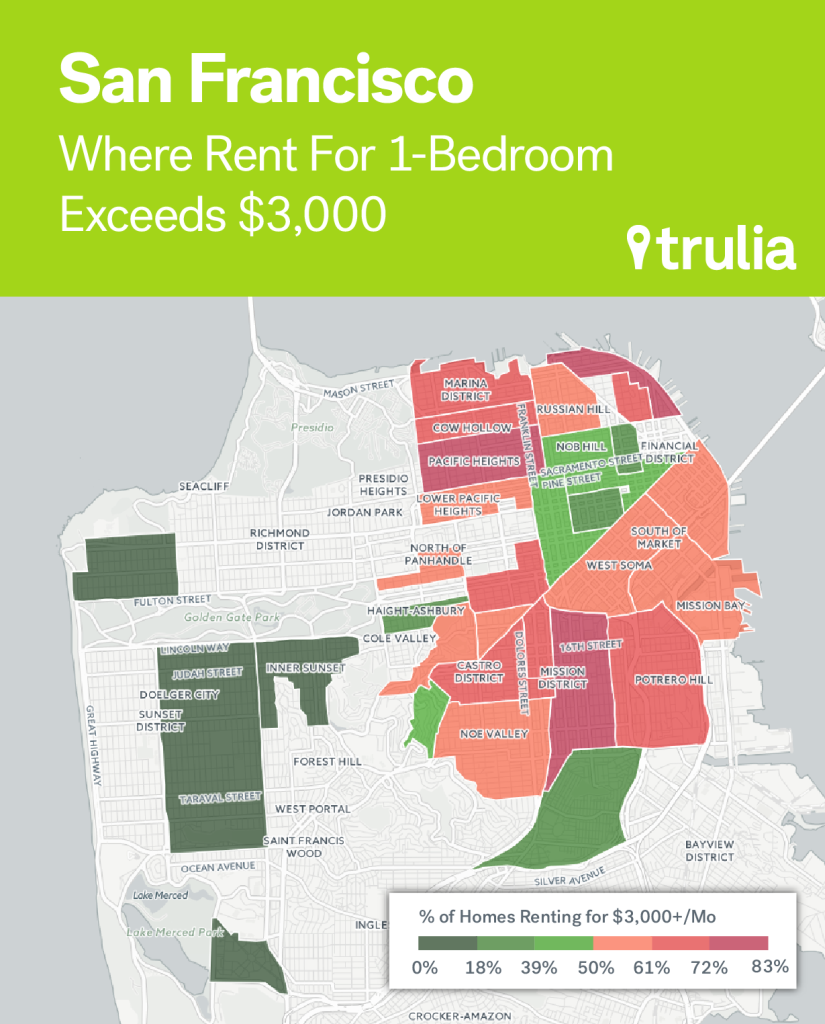
So you’re looking for a one-bedroom apartment in San Francisco, and you have about $2,000 a month to spend. You know the city’s median rent is more than $4,200 a month, but median means half the apartments cost less. Surely there are larger, more expensive apartments pulling up the midpoint.
Perhaps. But there’s a reason Google employees are sleeping in their trucks.
Ninety-one percent of one-bedroom apartments in San Francisco cost more than $2,000 a month. Perhaps more surprising is the number of apartments that occupy the high end of rental rates: In Manhattan, a fifth of one-bedrooms rent for more than $4,000....We’ve long known these are pricey rental markets. What these numbers show is the sheer scarcity of small apartments for rent at anything resembling a low rate in the country’s most desirable cities.


-RW

Tuesday, October 27, 2015

DeLong: No Accelertaing Price Inflation in Sight

Right next to my "Paul Krugman Deflation Warning"  file, I am placing a new file, the Brad Delong "There is No Acceleration in Inflation Coming" file.

DeLong links to Nick Bunker who says:
This is entirely consistent with inflation-expectations anchored near 2%/year--or inflation so low that shifts in inflation expectations are not a thing... 
[N]ot only does the right wing of the Federal Reserve expecting an imminent upswing of inflation because of MONEY PRINTING! have it wrong, it strongly looks as though the center of the Federal Reserve has it wrong too...
My expectation is that there is a very high probability that price inflation in 2016 will climb far above 2% (as measured by government price indexes). First stop 3%, then 5%. And that's in my file!

-RW

Tuesday, November 11, 2014

This Is The Big Factor That Could Set Off Accelerating Price Inflation at Any Minute


Shane Ferro writes for Business Insider:
Renting is all the rage these days, and the tightening of the residential rental market is the biggest threat to inflation, according to Ian Shepherdson, the chief economist at Pantheon Macroeconomics. 
The logic is simple. When there are few places to rent, landlords will jack up prices.
This chart was featured in Shepherdson's new monthly chartbook. We reached out to him to ask him why this is the biggest threat. Here's what he had to say: 
"...it's by far the biggest component of core CPI, accounting for about 40% of the index.  Rents reflect the vacancy rate (very low and falling) and wage growth (very low but about to accelerate, given the drop in unemployment and the pressures evident in surveys like the NFIB) so the risk is substantially to the upside.  Rents are much bigger driver of inflation than all the things people think of as indicative of price pressures, like clothing, tech gadgets, prescription drugs, cars, etc."
Shepherson has cautioned about falling vacancy rates being a threat to inflation before. Here's a quote from a note he put out in August (emphasis Shepherdson): 
"...a sharp and continuing decline explains the gradual upward pressure on rents, which we think are likely ro rise much faster once wage gains begin to pick up. Landlords are likely to be prime beneficiaries of faster wage gains, in our view, because tenants clearly have a shrinking pool of other options. Remember, rents and rent-equivalents account for 40% of the core CPI."

Wednesday, October 29, 2014

Estimated Effect of Lower Energy Prices on Inflation

The current growth in domestic oil production will mean, short-term, a decline in energy prices. In the chart below the impact, on the core CPI inflation index, of this energy sector decline can be seen via Capital Economics forecasts.

I must hasten to add, however, the CE forecasts do not take into account the eventual decrease in the desire to hold cash balances which will act as a countervailing force to downward pressure on CPI as a result of increases in energy productivity.

Also, note well that even after taking into account the downward pressure on prices because of the energy boom, CE is still forecasting that price inflation by the end of 2016 will be significantly above the Fed's "target" inflation rate.

They are correct that price inflation will intensify even with the gains in energy productivity, however, it is likely to intensify sooner than CE is forecasting and the climb is likely to be much stronger.


Monday, October 27, 2014

Early Indications are that US Christmas Spending Will Be Strong

The Gallup Poll's  initial estimates of the total amount Americans will spend on Christmas gifts this year point to an above-average holiday season for the nation's retailers.

Gallup's October spending forecast is an initial read before its key measure in November.  The organization  finds Americans expecting to spend $781, on average, up from $704 last November.

The current figures are based on an Oct. 12-15 Gallup poll of 1,017 U.S. adults, aged 18 and older.


Remember. the greater the desire to spend cash balances, the more potential for accelerated price inflation.


Thursday, October 23, 2014

Wage Expectations Back to 2006 Levels

The Fed's mad money printing is resulting in the masses becoming optimistic again. Wage expectations are soaring. Will this mean that they will lower their desire to hold cash balances? I believe so. The lower the desire to hold cash balances declines, the greater the price inflation will be.

Mainstream economists, who simply are projecting out current price inflation trends, have no clue as to how this occurs. They have no idea how quickly price inflation can accelerate once the tide turns toward aggressive consumer spending.


Former Plunge Protection Team Member: The Statistics Don't Reflect the True Rate of Price Inflation

Former Plunge Protection Team member Philippa Malmgren, president and founder of DRPM Group, told an audience at the the 2014 European Investment Conference that  Western governments are deliberately defaulting on their mountains of debt without it being formally called a default.

She claimed they are doing so by manufacturing inflation through unprecedented monetary expansion, thereby lowering the purchasing power of creditors, which include some of the most powerful countries in the world, most notably China.

Malmgren contended that inflation is not being reflected in the statistics published by central banks in the West but it is very much there. The rising prices of key items — such as wheat in the Middle East, pork in China, and onions in India — are causing ripples in those societies. She also believes that it is a misconception that inflation does not matter in the West, adding that the top issue in the United Kingdom in the coming 2015 national elections is the rising cost of living (though inflation indicators published by the Bank of England may not suggest the same).

(via Usman Hayat)

Tuesday, October 21, 2014

Market Volatility Since the 2008 Financial Crisis

Recent market volatility has been the result of the stock market. I expect the next crises in the economy to fool everyone and come from entirely different directions: The bond market and price inflation. It won't happen right away because declining energy prices will subdue the price inflation indices for awhile, but once the energy price declines are factored in watch out.

Monday, October 20, 2014

Price Inflation for the Masses: McDonald's Gets More Expensive

Gasoline prices are falling and that will mean subdued climbs in various prices indexes, but that doesn't mean prices aren't climbing in other sectors. Including McDonald's. where millions eat daily.

Bloomberg reports:
While the company still offers several items for $1, its menu is quietly getting more expensive. McDonald’s said its prices were up about 3 percent through the end of June compared with 12 months earlier. That’s more than the 2.5 percent gain in prices for food Americans purchased away from their homes in the year through August, according to the Bureau of Labor Statistics.. 
McDonald’s famous Dollar Menu now includes items that cost more than $1, and other items are creeping above $5. At some McDonald’s locations in Chicago’s Loop, a Double Quarter Pounder with cheese, fries and a drink totals about $7.50. Chicken Club sandwiches are $4.45, $4.99 and $5.19 at different Chicago McDonald’s restaurants, without sides or a beverage...
Restaurants are being pressured into boosting prices because of rising beef, cheese and pork prices...U.S. restaurants plan to boost prices 2 percent during the next six months, more than the 1.7 percent average increase from the prior 12 months, according to an October survey by restaurant researcher MillerPulse in Atlanta.

Sunday, October 19, 2014

A Key Indicator to Watch that May Be a Strong Indicator of Future Price Inflation

By Robert Wenzel

The Fed has pumped massive amounts of new money into the system since the financial crisis of 2008, so where is the price inflation?


Part of the answer is soaring productivity, especially in the energy and high tech sectors,

But another part of the answer is the strong desire by individuals and corporations to hold on to large cash balances. A very rough indicator of this is the declining velocity of money, since the crash.

There was a major decline in velocity during the Dot Com Bubble, but the it started to recover again, only to nosedive in line with the more recent financial crisis.


What could turn this around? At this point, consumer and corporate optimism. Which is why I keep a close eye on the the Thomson-Reuters/University of Michigan sentiment index. The more optimistic consumers are at this point, the more likely they are going to spend more of their cash balances.

The  preliminary October sentiment index "unexpectedly" (by Keynesian economists) increased to 86.4 from the final September reading of 84.6, according to a source who has seen the numbers, reports WSJ.

It's a continuation of increases in sentiment since the lows reached during the peek in the financial crisis.


At some point, the sentiment will become so positive that consumers will start spending so aggressively that it will overpower any productivity gains and that's when price inflation will really kick in. Timing on this is always difficult, but the trend is pretty obvious.

The Fed, Paul Krugman and most Keynesians (except probably Marty Feldstein) do not understand this. They are simply watching the current price inflation trendline (of just under 2%) and are projecting this out in their heads without understanding the powerful underlying force that will eventually cause price inflation to rocket.

Be prepared my friends, it's coming.

Robert Wenzel is Editor & Publisher at EconomicPolicyJournal.com and at Target Liberty. He is also author of The Fed Flunks: My Speech at the New York Federal Reserve Bank. Follow him on twitter:@wenzeleconomics

Thursday, October 16, 2014

AMAZING: US Oil Production is at a 30 Year High

Advances in technology are the main drivers behind the current decline in oil prices. And itis a great thing, not to be feared.

Only the Paul Krugman and Tyler Cowen types fear this great decline in prices. In their bizarre world, cheaper prices are a great deflationary threat. Apparently, in their world, things were much better better when oil was over $100 barrel and desktop computers  cost $5,000 plus.

BUT, enjoy the price decline while you can, the Fed is on a long-term money printing scheme that will counter the short term decline in oil prices.


(chart via Mark Perry)


Saturday, October 11, 2014

Fed Bank President Calls for Zero Interest Rates Until 2016!

Chicago Fed President Charles Evans during a speech today said that the Federal Reserve shouldn’t raise interest rates until early 2016.

“The U.S. economy is looking stronger than it was a year ago,” he said. However, “there continues to be significant underutilization of labor,” he added. “I don’t think inflation is going to take off any time soon.”

He sees inflation staying below the Fed’s 2% objective “well past 2017.”

Bottom line: There are serious money printers at the Fed, Although I suspect that price inflation may slow over the very near term (SEE: Economists Have Downgraded Estimates for Inflation Due to Falling Oil Prices and a Strengthening Dollar), Fed members are simply projecting current trends out into the future. They have no idea how quickly price inflation can accelerate once it starts a serious upward projection.

Evans' remarks are further evidence of my view, and that of Martin Feldstein, that the Fed is going to raise rates very slowly and that at some point price inflation is going to jump way ahead. (SEE: Price Inflation Propaganda from National Review)

The Fed shouldn't be manipulating money supply and interests at all, but this Fed is exceptionally dangerous. We not only have a drunk teenager behind the wheel of the economy, but a drunk and blind teenager behind the wheel.

Thursday, January 12, 2012

Krugman Calls for Even More Money Printing

How wrong can a Keynesian get? Pretty wrong.

Despite the fact that indicators continue to suggest that Bernanke's money printing is impacting the economy and that price inflation is likely the next development, Keynesian Paul Krugman wants the Fed to continue to keep interest rates near zero, which means more money printing.

Krugman writes:
Aha. Greg Mankiw tells us that when you apply the coefficients for his suggested simple Taylor rule (a rule for setting the Fed funds rate), it shows the desired rate closing in on zero from below, suggesting that the end of the liquidity trap may be near.. If nothing else, we’ve learned that the liquidity trap is neither a figment of our imaginations nor something that only happens in Japan; it’s a very real threat, and if and when it ends we should nonetheless be guarding against its return — which means that there’s a very strong case both for a higher inflation target, and for aggressive policy when unemployment is high at low inflation.

The bottom line is that the Fed almost surely won’t, and very surely shouldn’t, start raising interest rates any time soon.
Krugman is right that the Fed is not likely to raise interest raise anytime soon. However, he is dead wrong that this is a good thing. Price inflation is never a good thing, but especially at the early stages of a recovery, when prices are likely to start accelerating anyway.

His advise will comeback to haunt him, on this, just like so much of his commentary does.

Friday, January 6, 2012

Further Improvement in Unemployment Confuses Keynesians

The U.S. unemployment rate fell to 8.5 percent last month and nonfarm payrolls rose by 200,000, according to the Bureau of Labor Statistics.

The hiring gains cap a six-month stretch in which the economy generated 100,000 jobs or more in each month. That hasn't happened since April 2006, before the start of the financial crisis.

Paul Krugman-like Keynesians remain totally confused. Keynesian economists surveyed by Dow Jones Newswires had forecast a gain of only 155,000 in payrolls and a jobless rate of 8.7%.

 Just last month while the hiring was going on Krugman wrote that we we are under depression conditions:
....under depression conditions — which is what we have now — inflation is very much a positive thing.
As for his call for more inflation, Krugman's last word on that was that he was worried about deflation, he is going to get smacked around big time in early 2012 with price inflation that will rocket even the silly core inflation index he watches.

Alreay, gasoline prices are starting the year off with a bang.They are at the highest-ever level for the start of a new year, ever.

The average U.S. price for a gallon of regular unleaded stood at nearly $3.28 on Jan. 1, according to AAA Daily Fuel Gauge Report.

That’s over 20 cents above the year-ago price and almost 63 cents above 2010’s starting level.

Bottom line, since Krugman doesn't understand how money impacts an economy, at major turns he tends to be way out of whack on his forecasts. Only Austrian business cycle theorists understand the manner in which central bank money manipulation can impact an economy. Bernanke money printing has been super-aggressive. This is behind the manipulated turnaround in the economy that was spotted first here at EPJ. The price inflation is coming.

(htRyanUnerwood)

Wednesday, January 4, 2012

Oil Above $103 per Barrel

Oil is a very important factor when it comes to real core price inflation.

As I have stated many times, oil is a key factor for consumers and also in the capital goods sector. This is important to understand in terms of Austrian business cycle theory, since ABCT teaches that central bank money printing directs money to the capital goods sector.

When the money falls into the hands of the capital goods sector, those operators then start bidding oil (and gasoline) away from consumer uses. It's a real bidding war. An operator in the capital goods sector is not going to be bidding directly from consumers for, say, cement, but he is going to be doing so for oil. That's why oil tends to lead price inflation.

In the EPJ Daily Alert, I have been warning about an upward spike in oil prices, Bernanke has been printing too much money for it not to happen, especially since the eurozone has somewhat stabilized and thus, the demand to hold cash (especially dollars) will shrink.

The cover story may be heated words between the U.S. and Iran, but the money has to be there to bid up the prices, and Bernanke is sure printing that.

Eventually, with capital goods operators bidding oil away from the consumer sector, it will mean much higher gasoline prices.


Monday, December 26, 2011

Bernanke Christmas Gift to Obama: Surging Poll Numbers

According to the latest Gallup tracking poll, more Americans approve of the job that President Obama is doing than disapprove for the first time since this summer, reports Politico.

The latest Gallup survey shows that 47 percent of Americans now say they approve of the way that President Obama is handling his job. This is a 5 percent improvement since the Dec. 16-18 Gallup survey and marks the first time the President's numbers have been in positive territory since July.

With economic numbers beginning to trend higher because of Bernanke money printing, more are becoming satisfied with the way the President is "running" the country. BUT, price inflation will not be far behind. Indeed, the price for a barrel of West Texas Intermediate oil is likely only a day or so away from breaking above $100 per barrel.


Will voters have improving Fed manipulated economic data or rising gasoline prices on their mind when they vote in November 2012? Will Obama impose some kind of price controls on the country in the late summer of 2012 to show he is "battling" inflation?

Friday, December 23, 2011

Bernanke Money Printing Benefits Tech Sector

I have pointed out earlier this year, one of the sectors getting its hands first on new Ben Bernanke printed money is the tech sector.

A new comment by John Shinal at Market Watch indicates this trend has continued through out the year and will likely continue into the new year:
It’s worth noting, because what Oracle is experiencing, and will continue to experience in 2012, also will impact every other U.S. tech company next year.

In short, salary costs per worker are headed higher, both for engineers and for sales staff with technical experience. Job opportunities abound for these prospects because their skills are in strong demand, as information technology becomes an ever-more important part of strategic planning for corporations.

For tech workers who are tired of their jobs, now is the best time in years to look for a new one that pays more. Fresh data and reporting provide evidence that the booming job market in technology is gathering more steam.

“Tech is one area that’s growing and thriving across the board,” said Adriana Ganos, a principal in the software-engineering practice in the Boston office of recruiting firm Winter, Wyman. “There are opportunities for everyone right now.”

For the last six years, Ganos has been helping put together software-development teams for start-ups and for “small organizations within large [tech] enterprises,” which she declined to identify.

She described the current state of her business as “very healthy … extremely healthy,” and added that West Coast companies are now coming to Boston in search of engineering talent.
What's going on here is that newly printed money tends to find its way to the capital goods sector, which includes the stock market and especially the IPO market.

The IPO market has been a huge funding source for the tech sector. In 2011, companies raised $36.3 billion from 125 IPOs. A good chunk of that ended up in tech. Groupon, LinkedIn, Jive Software, Zillow, Pandora Media and Zynga all went public this year. Zygna, alone, raised a billion dollars. That's a huge pot from which to bid for engineers.

As Bernanke money printing continues to hit the economy, the tech sector along with oil workers are likely to be major beneficiaries, ahead of the price inflationary curve.

(Thanks2JimWaddell)

Wednesday, December 21, 2011

Interesting Signal That Stronger Consumer Price Inflation may Be on Its Way

The 52-week high list is filled with broad-based key consumer related stocks.

CNBC tweets:
New 52-week highs: Wal-Mart, Pfizer, Verizon, McDonald's, Home Depot, Starbucks
These stocks are obviously climbing because business is good and sales are up. It also suggests these firms will be stronger bidders at the commodity and wholesale level , pushing commodity and wholesale prices higher, which will then in loop back fashion result in their raising consumer prices.


Friday, December 16, 2011

Paul Krugman as the Evil Jokester

Paul Krugman has another absurd attack on Ron Paul, most of which is not worth going over. It's his basic lies and distortions.

But I will comment on one of his most deceiving statements in his column. He writes:
So here we are, three years later. How’s it going? Inflation has fluctuated, but, at the end of the day, consumer prices have risen just 4.5 percent, meaning an average annual inflation rate of only 1.5 percent. Who could have predicted that printing so much money would cause so little inflation? Well, I could. And did. And so did others who understood the Keynesian economics Mr. Paul reviles. But Mr. Paul’s supporters continue to claim, somehow, that he has been right about everything.
This is apparently Krugman's new preferred method of deception, he also did it two days ago.

He lumps a period of low price inflation with a period of higher price inflation and declares, Viola! There is no inflation. In the paragraph above, he is taking a three year period (which included the Great Recession---the greatest economic calamity since the Great Depression, and a period where you would expect price inflation to decline, since it is a period of slowing money supply AND a period of high demand for cash balances) and he mixes it with a period of higher inflation. And puts out that the three year average annual inflation rate in only 1.5%. Well ,yeah Paul, but what happens if you look at price inflation during the rebound period in the economy, say, the last 12 months? Price inflation isn't anywhere near 1.5 percent.

I quote directly from the Bureau of Labor Statistics CPI release made today:

Over the last 12 months, the [CPI] all items index increased 3.4 percent.
That's a 127% greater rate of increase over the last 12 months than Krugman gives the impression of via his sleight of hand.

Worse, if you spend a good chunk of your money on energy, such as gasoline and heating oil, you are really getting smacked. Those prices are up, according to the BLS, by 12.4% over the last 12 months. (Gasoline is up 19.9%). Food, bought for the home, is up 5.9%. Apparel is up 4.8%.  In fact, of the top 20 categories and sub-categories identified by  the BLS, only 1 shows an increase over the last 12 months of less than 1.5%.  Four categories (surrounding energy) are up by double digits.

So if you stay at home and do nothing all day but read Paul Krugman posts on an iPad, maybe your personal inflation rate is zero, but if you eat at home or hop in your car, or keep the heat on in the winter, then unless you are a Krugmanite, you know that Krugman is an evil jokester that shouldn't be taken seriously.