Will the lefties demand his statues be torn down around the world and his books banned?

-RW


As semiconductor chip prices soar in the face of mad Federal Reserve money printing and tight chip supplies, this report comes in via June Yoon at The Financial Times:
[B]itcoin mining uses more electricity per transaction than any other method known to mankind.
Much less discussed, and yet perhaps more immediate, is mining’s impact on costs of chips — which go into everything from smartphones and TVs to cars.
Bitcoin is created by bitcoin miners, who are issued with the cryptocurrency in return for completing massive volumes of computations to verify transactions. This requires a high energy input. But miners also require increasingly powerful computer equipment, or rigs, for the process.
How quickly bitcoins can be mined is directly correlated to how advanced chips inside the rigs are. As the price of bitcoin rises, so does the profitability of mining...
The problem is that even without that growing demand from cryptocurrency miners, the semiconductor industry is struggling with a global shortage...
“Added demand from cryptocurrency miners is coming when the chip industry is dealing with simultaneous crises — from supply constraints to a structural shortage of high-end chips,” says CW Chung, head of research at Nomura in Seoul...
Shortages are affecting a broad range of industries. Automakers including Toyota and Volkswagen have slashed production of cars as a result. Smartphone makers are delaying launches of new models...
Besides specialised chips, miners are snapping up more computers and servers — which is pushing up demand for traditional Dram chips used in PCs. It does not help that the second quarter is traditionally the peak season for chips used in servers, crucial to the businesses of big tech groups like Google and Facebook.
All that has played a part in pushing prices of Dram chips up over 60 per cent in the past three months. While those have boosted chipmaker profits, the shortfall has wreaked havoc on the sector's previously predictable price cycle. Chip prices had been expected to fall last year. Now, another 20 per cent rise in consumer chip prices is expected from the second quarter as the shortage intensifies.
“Cryptocurrency industry demand can have a significant influence on the chip market — during the last bitcoin rally, they were a tenth of TSMC's entire sales,” says Chung.
Structural changes are making the situation worse. Smartphone and game console makers have changed purchasing habits, stockpiling months’ worth of chips ahead of a prolonged period of high prices...
Critically, chips are one of the most expensive components of consumer electronics devices such as smartphones and PCs. Increased supply to bring down prices will not be fast in coming. The process of sourcing raw materials and producing chips, which used to take at least three months, is getting longer. Building capacity takes years. There are few other suppliers that can produce at scale.
The price inflation that is about to hit the consumer sector is going to be really something.
Keep in mind that the current advance in cryptocurrency prices wouldn't be occurring without the recent massive money printing by the Federal Reserve. The money just wouldn't be around to push crypto prices higher if it wasn't for the Fed. And this price rise is providing crypto miners with the opportunity to bid materials, including chips, away from the consumer sector.
-RW
Yesterday The New York Times columnist Paul Krugman played down the coming inflation (See: It's Time to Panic: The Paul Krugman "Don't Panic" Indicator Just Kicked In).
Now Claudia Sahm, a Times contributing opinion writer who once worked as an economist at the Federal Reserve, is out with a column that claims price inflation is good for lower-income people!
She starts out with the puff-piece-style claim that Federal Reserve Chairman Jerome Powell and the Federal Reserve Bank staff are simply great:
[W]ith Jerome Powell as the leader of our nation’s central bank. The swift and steady action from the Fed, a commitment to getting people safely back to work and Mr. Powell’s calm-inducing pronouncements have earned him plenty of bipartisan credit. (There’s now even a wide cross-section of progressives who have become fans of his.) That said, Mr. Powell is not the only hero. The long, hard path to get a more worker-friendly Fed was generations in the making.
Then there is this absurd claim to justify coming inflation:
Inflation hawks seldom remind us that wealthy investors are hurt by inflation and lower-income borrowers are helped: For example, paying off a fixed-rate loan is easier when wages and prices rise by, say, 5 percent a year rather than 2 percent. People have more money to pay the debt, and when creditors get their money back, it’s worth less. When framed this way, zealously guarding against any significant uptick in inflation feels less like responsible stewardship and more like a classist double whammy — increased cost of debt and fewer jobs.
First of all, you can't believe in simple supply and demand economics if you think that price inflation is required to create jobs. Markets clear, even jobs markets.
As for the benefit of fixed-income debt during a period of strong inflation, it is true that there is a benefit for the holders of such debt. But Sahm is very misleading in her phrasing of who benefits.
"Lower-income" borrowers with fixed debt do benefit but the lowest income debt holders have adjustable-rate debt, not fixed debt. As inflation climbs and interest rates go up, they are squeezed, especially if they are on fixed incomes. And every major corporation in America today has issued massive amounts of fixed-rate corporate debt that will benefit to a much greater extent than a low-income individual.
Now, as a sidebar, comes the woke cultural-Marxist moment in the Sahm essay which is apparently required in any opinion piece these days at the Times:
The Fed is still learning. In the late 2010s, I helped with some of that introspection. We asked ourselves whether we were producing our best work or if we were succumbing to groupthink. We grappled with why we missed the 2008 financial crisis, why we ignored the warning signs and how to do better next time.
Among the fruits of this labor was an analysis conducted in 2015 exploring whether the staff consensus was underestimating how many more jobs the economy could create without sparking too much inflation. We also tried to tackle groupthink by trying to increase diversity among the staff, under Ms. Yellen and later Mr. Powell. And I am heartened by the changes so far. But even today what’s known as the “staff view” looms large, and only a handful of the hundreds of economists at the Federal Reserve Board are Black economists.
And then the Sahm conclusion which falls in line with Krugman to ignore the coming price inflation and warnings about it:
If you think the hawks on television and Twitter are loud now, just wait until they see a temporary uptick in prices. They’ll be deafening. Some are inside the Fed itself and will be voting on its policies. That said, there are also many wonks at the Fed who have spent a decade shoring up technical defenses against outdated inflation fears.
But their words in long-winded memos are not enough. Good intentions are not enough. It’s what the Fed does this year and the next — in the face of inevitable criticism from incredibly powerful voices stuck in the past — that will ultimately matter most.
There you have it another New York Times voice attempting to play down the coming price inflation.
LOL, "outdated inflation fears" as the inflation tsunami is about to hit.
-RW

The recent surge in chip prices hasn’t affected consumers, and stimulus has kept spending up while confidence has lagged. But that will soon change. Manufacturers have been eating the increase costs and not passing them on to consumers. With chip prices expected to rise every quarter this year, many companies will be unable to keep swallowing it, especially those with tight margins.Manufacturers order semiconductors six months in advance. The choke points along the supply chain driving up prices and creating shortages will come to a head in the third quarter, when the next orders to replace inventories are delivered, according to the founder of SouthBay Research Andrew Zatlin.Automakers will struggle to hold the line. At General Motors, for example, roughly 5% of the cost of goods sold is from semiconductors. The company has 11% margins, and a surge in chip prices will hit profits hard, according to Zatlin. And small business who sell to the likes of Amazon and Walmart with tight retail margins will be forced to raise prices even higher.
The impact should only spread from there. Which is why this jump in inflation won’t be transient as the Fed hopes. Every manufacturer with tight margins will be forced to raise and maintain higher prices. So get ready for some serious sticker shock very soon.
If you are planning on buying anything that has semiconductors in it, BUY NOW!

Here, according to The Washington Post, are the tax hikes Biden (read his controls) want to institute:
- Corporate rate 21to 28% - Global minimum tax to 21% - Top income rate to 39.6% - End fossil fuel subsidies - Tax investment gains greater $1M as wage income - Tax assets passed on at death Also end the Trump insituted SALT (limitation state and local tax deductions)
Fortunately, at this point, there appears to be even some Democratic opposition to the desired tax hikes.
Of course, the hikes would only hamper free markets and distort the economy in favor of the bureaucratic-crony government money flow.
-RW
On New Year's eve, The New York Times dropped a column by Paul Krugman.
He was very optimistic.
He concluded the piece this way:
[A]ll in all, there’s a pretty good chance that Joe Biden will preside over an economy that surprises many people on the upside. Happy New Year.
There was no mention of inflation in the column. Zero
He said that the economy wouldn't need any kind of major bailout:
[T]his time the economy won’t need support as badly as it did during the Obama years.
Obama's spending package, in the end, amounted to $831 billion. Biden's recent spending package was more than twice that at $1.9 trillion.
Despite his column claiming no major government spending support would be needed, less than 90 days later Krugman, loyal lefty apparatchik that he is, fully-backed Biden's monstrous spending plan.
Now, he seems to be aware price inflation is coming. His latest column is titled, How Not to Panic About Inflation.
In it, he writes, "There will almost surely be a rise in inflation, too, possibly well above the Fed’s target rate of 2 percent a year." And this, "So what’s going to happen in the months ahead? We’ll probably see a number of transitory price increases..."
LOL, he knows what's coming and the best defense he can come up with at this point to protect Senile Joe is to conclude his column this way:
Now as then there are people eager to denounce government attempts to help the economy. And it’s certainly possible that the American Rescue Plan will turn out, in retrospect, to have been too much of a good thing. But don’t let the usual suspects seize on a few months’ inflation data as evidence of looming disaster.
It is time to buy more gold and silver. The Krugman "don't panic" indicator just kicked in.
-RW
The Treasury used to have a web page that detailed economic data about the country, but when you go to this site now, this is what you see:

When you click on the link provided, this is what you see:
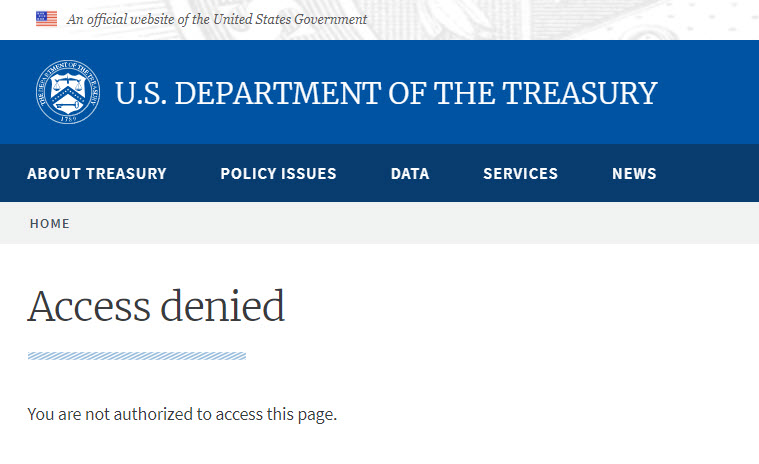
Keep in mind this is at the same time that the CIA no longer publishes data in its CIA Handbook on money supply growth in each country and the Federal Reserve has stopped reporting weekly money supply data in a timely fashion.
In a day and age when it is easier than ever to accumulate data and publish it, it appears the U.S. government is starting to aggressively report less data about the economy.
What are they hiding?
-RW
I really had no idea there were so many podcast platforms until I launched an early version of This Week in Economics with Robert Wenzel.
Below are the platforms that have been used to listen to the show.
Find it on your favorite platform, or go here.
-RW

As the Federal Reserve Bank pumps massive amounts of money into the system, the price of lumber is soaring.
Specifically, the price of lumber per thousand board feet is at $1,044, according to Random Lengths. That's an all-time high, and up 188% since the onset of the lockdowns, COVID-19 panic and massive Federal Reserve bank money printing.
The National Association of Home Builders calculates that current lumber prices are adding at least $24,000 to the price tag of a typical new single-family home.
It is only the beginning folks, price inflation is going to expand across most consumer markets in the months to come.
There is a modern monetary theory hold on the thinking at the Fed whether members want to admit it or not. MMT holds the bizarre view that government debt doesn't matter and large amounts of money printing is not a problem.
We shall see.
-RW
(via @Mens_Corner_)
Agility Robotics has partnered with Ford to develop a delivery solution that includes a self-driving van with a robot in the back.
 |
| Larry Summers |
In a Bloomberg TV interview, former U.S. Treasury Secretary Lawrence Summers warned about current macroeconomic policy.
“I think this is the least responsible fiscal macroeconomic policy we’ve have had for the last 40 years,” he said.
He said there is a 1/3-chance that inflation will accelerate in the coming years and the U.S. could be face stagflation. He also saw a 1/3-chance of no inflation because the Fed would hit the breaks hard and push the economy near recession. The final possibility is that the Fed and Treasury will get rapid growth without inflation.
“But there are more risks at this moment that macroeconomic policy will cause grave risks than I can remember,” he said.
I rank the price inflation threat much higher than Summers (around 90%0 and Summers looks at things from a Keynesian perspective but you do have to give him credit for being one of the very few mainstream economists speaking out against the current mad government spending and money printing.
He seems to be one of the few that hasn't been swept up into the MMT voodoo world thinking where deficit spending and money printing don't matter.
-RW
 Podbean
 Apple Podcasts
 Google Chrome
 Overcast
 Stitcher
 Safari
 Pocket Casts
 PodcastAddict
 Google Podcasts
 Spotify
 iTunes
 Downcast
 Player FM