Showing posts with label RealEstateBubble. Show all posts

Thursday, July 31, 2008

Greenspan Talks and You Should Listen

In a wide ranging interview on CNBC with Maria Bartiromo, former Fed Chairman Alan Greenspan provided one of the best overall analyses of the current economic situation.

As we have pointed out in the past, Greenspan studies the details of economic data better than any other economist. The one weakness Greenspan has is that, amazingly, he doesn't have a business cycle theory. This weakness displays itself briefly in the interview, but for the most part it is top notch commentary by Greenspan.

Significantly, as we have pointed out also, Greenspan understands that the current crisis is housing and housing finance crisis, rather than a full-fledged recession.

But,Greenspan does not, and this is where his lack of a business cycle theory comes in, discuss the current slowdown in money supply that could throw the economy into a full-fledged recession.

From his data digging, he points out that currently there are some 12 million homeowners that have negative equity in their homes. Of course, homes with negative equity are homes very susceptible to foreclosures and walk aways. It is these kind of numbers that cause Greenspan to say that the US is “nowhere near the bottom” of the housing slump.

Greenspan also warned that "Fannie and Freddie are a major accident waiting to happen," and speculated that the two may eventually have to be nationalized.

He very perceptively warned that the plan Treasury Secretary Paulson is pushing to put the Federal Reserve in the role of regulator of the financial sector is foolhardy and such a role by the Fed would end in failure by the Fed as all factors are never known in advance and thus it is impossible to regulate them in advance. Hear, hear!

He also very perceptively pointed out that the financial crisis shall ultimately pass, but the real long-term problem will be inflation and stagflation.

In a moment of complete honesty, he pointed out that during his reign as Fed chairman productivity growth suffocated inflation problems, but that now the tide has turned and inflation is a much bigger problem than when he was Fed chairman.

Part 1 of the interview is here.

Part 2 of the interview is here.

Secretary Paulson on The State of the Housing Market

Treasury Secretary Henry Paulson spoke today on the Markets and Economy at the Exchequer Club, in Washington D.C. As part of his remarks, he provided an overview of the current state of the housing market (our emphasis.)

It took years of excesses – lax underwriting standards, excessive home price appreciation and overbuilding – to sow the seeds of the housing correction.

That said, we need to recognize that there is not a national housing market, but a collection of regional markets. The severity of the current correction varies widely by state and region. Areas that had some of the most pronounced price appreciation are facing the most pronounced price declines and foreclosure increases. Of course, that does not mean the correction isn't being felt across the nation. Foreclosure starts as a share of total outstanding mortgages have risen from 0.4 percent to 1.0 percent since the beginning of 2006. However, OFHEO's home price data shows that home prices actually rose in about half of the states in the first quarter.

Due to overbuilding in prior years, home inventories are now far above normal levels. At the current sales rate, there is a ten month inventory of new single-family homes on the market, and an 11 month inventory of existing single-family homes. This compares with a historical average of about six to seven months. The key to stabilizing the housing and financial markets is to work through these home inventories as quickly as possible.

Inventories decrease in two ways – fewer homes are built, and more buyers come into the market. We are seeing the necessary sharp decline in homebuilding. Single-family housing starts are down 65 percent from their 2006 peak and look to remain weak through this year.

New home sales appear to have stabilized to a degree – sales of new single-family homes are down 62 percent from their peak; and sales have been flat, rather than declining, for three months now. The drastic slowing in new construction has helped reduce the number of new single-family homes on the market, which is down 26 percent since its 2006 peak. The number of existing homes on the market remains elevated, but there are also tentative signs that sales in this category have been stabilizing since early 2008.

We all recognize that foreclosure sales increase inventories and, as foreclosed homes are put on the market, they drive down prices. Foreclosures and short sales now make up about one-third of existing home sales....

Foreclosures and existing home inventories are likely to remain substantially elevated this year and next and home prices are likely to decline further on a national basis. The key question is, "When will the correction be largely behind us?" While home price adjustments will continue for some time, and certainly well beyond the end of the year, I believe we can move through the bulk of the correction in months rather than years.

Tuesday, July 29, 2008

S&P: Home Prices Drop By Record 12-Month Decline of 15.8% Through May

Home prices fell by the steepest rate ever in May, according to The Standard & Poor's/Case-Shiller 20-city index.

No city in the Case-Shiller 20-city index saw price gains in May, the second straight month that's happened. The monthly indices have not recorded an overall home price increase in any month since August 2006.

Nine metropolitan cities — Las Vegas, Miami, Phoenix, Los Angeles, San Diego, San Francisco, Seattle, Wash., Portland, Ore., and Washington, D.C. — posted record lows in May.

Las Vegas recorded the worst drop, with prices plunging 28.4 percent over the last 12 months ending May 2008. Miami came in a close second, with prices down 28.3 percent over the last 12 months.

Charlotte, N.C., posted the smallest drop of 0.2 percent ovrr the last 12 months enging in May 2008. Until April, the North Carolina city had been the last metro still showing price gains.

"The Sunbelt led by Miami, Tampa, Phoenix, Las Vegas, San Diego and Los Angeles saw the biggest booms and now see the largest declines. The Northeast, including Boston and New York,is cyclical but less volatile while the Midwest, paced by Detroit and Cleveland face difficult local economies” said David M. Blitzer, Chairman of the Index Committee at Standard & Poor's.

Note: Be careful of the AP numbers being put out which are using a headline that reports a decline in May of 15.8%, without reporting this is for the 12-month period--not a decline of 15.8% for just the month of May.

Tuesday, July 22, 2008

Los Angeles Condo Sells for $47 Million

...to Candy Spelling, the widow of TV mogul Aaron Spelling.

She bought the two top floors of a Century City residential tower still under construction.

This has zero reflection on the economy, since Spelling money has accumulated over the years, boom times and bad. Though, it is certainly going to skew the average price bought for a condo in LA, in 2008.

Aaron Spelling holds the record for most prolific television producer, with 218 producer and executive producer credits.

With Danny Thomas, Spelling produced: Mod Squad. With Selley Hull, he produced, The Rookies and Charlies Angels. He also produced, or was otherwise involved with, Dynasty, Starsky and Hutch, Family, Hotel, Beverly Hills 90210, Melrose Place, The Love Boat, Fantasy Island, Vega$, Hart to Hart, The Colbys, T.J. Hooker, Nightingales, Kindred: The Embraced, 7th Heaven, Charmed, Burke's Law, Honey West, and S.W.A.T.

That's how your widow gets to buy a $47 million condo.

Sunday, March 18, 2007

The Truth About Alan Greenspan and the Real Estate

Alan Greenspan continues to warn about problems in the real estate markets and other parts of the economy. But with every warning, Greenspan paints a picture that suggests the problems have nothing to do with his irresponsible money management during his reign at the Fed. In truth, if one man can be blamed for today's problems in the real estate markets, it is Greenspan. He flooded the home mortgage market with trillions of dollars during his watch.

Here are the cold hard facts:

When Greenspan took over at the Fed in 1987, total outstanding US home
mortgages stood at only $1.82 trillion.

By 1999, total outstanding mortgages in the US stood at $4.45 trillion.

By 2004, US home mortgages stood at $7.56 trillion.

In 2005, Greenspan's final full year as Fed chairman, home mortgage debt
outstanding amounted to $9.1 trillion.

Here is some of the jawboning Greenspan conducted while he was Fed
Chairman.

In 2003, he called the refinancing of housing, "support" for the economy:

The outsized dollar volume of these refinancings--by our estimates, $1-3/4 trillion net of cash-outs--was an all-time record and represented almost
one-third of the value of all regular home mortgages outstanding at the
beginning of last year...An even greater support to the economy than cash-
outs last year was the extraction of home equity associated with a record
6.4 million existing home sales, including condos, at record prices.


And he basically advised not to worry about a housing bubble:

...any bubbles that might emerge would tend to be local, not national, in scope... In evaluating the possible prevalence of housing price bubbles, it is
important to keep in mind that home prices tend to consistently rise relative
to the general price level in this country...A sharp decline, the consequences of a bursting bubble, however, seems most unlikely...Here is Greenspan spinning things now, as though he had nothing to do with the problem.


On March 15 of this year, he said:

You can't take 10 percent out of mortgage originations without some
impact...


In October 2006, he blamed the entire thing on the Berlin Wall coming down:

I dont think that the boom came from a 1 per cent Fed funds rate or from
the Fed’s easing. It came from the collapse of the Berlin Wall.


The Berlin Wall??

In 2003, while discussing refinancings, he came closer to the truth:


Owing largely to the lowest mortgage interest rates in more than three
decades and rising home prices, close to 10 million regular home mortgages were refinanced.

There are massive distortions in the economy right now, caused by
Greenspan's low interest rate monetary policies when he ruled the Fed.
Many different sectors could implode: further problems in real estate, the
carry trade, the hedge fund industry, etc. Greenspan knows this. He sees
that the economic tsunami wave is about to hit. His warnings should not be
taken lightly. He created the mess ahead. He knows it and understands how
bad things can get.

Saturday, August 26, 2006

Who Owns All the Mortgage-Backed Securities?

As signs of real estate collapse become all the more obvious, the big question has to be "Who owns all the mortgage-backed securities?".

Total market value of all outstanding U.S. MBS at the end of the first quarter of 2006 was approximately $ 6.1 trillion, according to The Bond Market Association.

Think about that, a $6.1 trillion debt sector where the underlying collateral is declining in price. Wall Street has sold these securities to every nook and cranny of the investment world. There are going to be huge MBS portfolios that will be underwater once the foreclosures start. It is going to damage retirement plans and much more. We trust you don't own any of this stuff.

Sunday, August 20, 2006

Reckless Real Estate Loans

This note is about the wacky loans being made in the real estate market. But first, we wish to emphasize that the ultimate cause of the real estate slowdown is not wacky loans, but the micro-managing of the economy by Federal Reserve money manipulations. First they pump huge amounts of money into the economy, then they raise rates and cut the money flow. The loans are a byproduct of the Federal Reserve money pumping activity.

But, the types of loans being created for the housing market will result in the real estate crash coming sooner than would otherwise be the case, and also deeper. WaPo reports that loans that are being made "include interest-only mortgages and 'option' mortgages, in which borrowers decide each month how much to repay."

WaPo goes on to state:


Many borrowers are paying as little as possible. About 70 percent of the people who take out an option adjustable-rate mortgage, which lets the buyer avoid paying even the full interest on the loan, end up paying the lowest permissible amount each month, according to the Federal Deposit Insurance Corp... The amount unpaid is added to the mortgage balance, so borrowers end up owing more than when they started. Having no equity in a home increases the risk of foreclosure, especially when housing values fall and houses are hard to sell...

In 2000, just 1 percent of American homeowners who got new loans had these types of loans, but by May 2005, about a third of all borrowers did -- about the same percentage as in May 2006, according to new data from First American LoanPerformance, which tracks the statistics.


It's an open secret these loans are a problem. WaPo again:


"We are deeply concerned about the potential contagion effect from poorly underwritten or unsuitable mortgages and home equity loans," Suzanne C. Hutchinson, executive vice president of the Mortgage Insurance Companies of America, wrote in a recent letter to regulators. ". . . The most recent market trends show alarming signs of undue risk-taking that puts both lenders and consumers at risk."

We have speculated on these pages that the Federal Reserve will at some point open the floodgates and pour enormous amounts of money into the system, when some type of financial or economic panic occurs. We have not speculated as to where in the financial system or the economy such a panic will occur. There are many, many possibilities. But looking at the current structure of the real estate market, one can not rule out a major panic or problem by those holding all these mortgages where foreclosures are almost a foregone conclusion.

One question that remains is who is holding this high-risk mortgage paper. Banks are to a large degree making these loans, but they are then securitizing the mortgages and selling them off. But someone is ultimately holding this wacky paper. Is it pension funds? Hedge funds? Unfortunately, in time, it is likely we will learn when the entire structure collapses.

Sunday, July 16, 2006

The Real Estate Market View from Beverly Hills

The housing market continues to deteriorate and now the credit problems are starting to emerge. Yesterday, we had a meeting with a Beverly Hills mortgage broker who has been in the business for more than 40 years.

He tells us that he expects many credit problems for low and middle class wage earners. In some cases, he tells us, home owners have borrowed, between mortgages and home equity lines of credit, four or five times against their houses.

He told of one case that had just come across his desk,a woman,who years back, had paid $200,000 for a home with $50,000 down. As the price of the property climbed in value, she borrowed against the house. First $15,000. Then $50,000. Then $100,000. Then another $80,000. Including her first mortgage, she had borrowed against the house five times.

From each new loan, she used funds to make payments on her earlier outstanding home loans, and just plain spent a lot of the money on personal items. Now that the real estate market has stopped climbing in value, she is not able to get anymore loans. Her current situation: She has monthly loan payments of $4,200 per month. Her income from her job as a secretary is $2,500 per month.

There is no way she can meet her financial obligations. She is going to lose her house. We remarked, "She must be in shock." Our mortgage broker friend replied, "She is numb. It is hard to even carry on a telephone conversation with her. You can tell she is having difficulty processing the situation she is in."

Our friend claims that across the country there are hundreds of thousands that will be in the same situation. And although he expects the brunt of the crisis to be absorbed by the low and middle class, he tells us that there are going to be some spectacular celebrity bankruptcies in six months or so. He personally knows of two situations that are developing right now.

He tells us that there are some super-wealthy in Beverly Hills, but most are in debt up to their plucked eyebrows. "It's a lot of show. Many, many of them don't have a penny in the bank," he says. "There will be some newsmaking bankruptcies."

Tuesday, June 27, 2006

This Babe is Betting Big that Bernanke goes on a Bender

We recently had a conversation with a woman who just started dabbling in the real estate market. For purposes of this note, she will be referred to as Jane.

Jane is a legal secretary in Los Angeles and doesn't strike one as the type that would, say, belly up to a Vegas crap table and lay a grand down on one throw of the dice. Yet, Jane is making a big bet, much bigger than a grand, that Ben Bernanke will bail her out of a stupid investment.

Jane bought a loft, for investment purposes, in downtown Los Angeles. It's a small loft. We have actually lived in residences that had bigger bathrooms than the size of this entire loft unit. Whatever she laid down for this dog house, Jane confessed to us that her monthly nut--mortgage payment, real estate taxes and common fees-- amount to about $2,200 per month. She has owned the loft for three months. It's still not rented.

At first she tried to rent it out for $1800 per month. She is now down to $1400 per month and still no takers. Welcome to the final stage of the real estate boom. Jane is dead in the water on this baby. Who the hell loaned her the money for this nutty investment? She is paying out of her own pocket the monthly $2200 hit. And while all this is going on, Ben Bernanke and his brigade are still raising interest rates. The real estate market is slowing already, before any further hikes. The next hike will destroy the value of this loft. It will tank in price.

Jane may not understand, but you need to keep your eye on the Fed before making real estate investments (or most other investments for that matter). The Greenspan years at the Fed will someday become known as the easy years. Easy money, easy times. We don't think Bernanke will get off so lucky.

When the Fed is flooding the markets with easy money, it bails out a lot of people who make stupid stock market investments and stupid real estate investments. Tough times are tough for even the shrewd. Jane is not in the shrewd camp. Her investment is going down the tubes, unless of course Bernanke loses his mind, goes on a days long bender, walks back in the office about a week later, and in a tequila fueled craze cuts the discount rate, cuts the reserve requirement and cuts the Fed funds rate, just because it feels good. Not likely, but that in essence is what Jane is betting on.

What are you betting on?

Monday, May 2, 2005

In The Enron Audience

Saw the Enron documentary film on Saturday.

The woman sitting next to me kept letting out an all knowing laugh every time the film showed a clip of Ken Lay or Jeff Skilling saying something positive about Enron in the days before the collapse.

Somehow I doubt she was so all knowing before the collapse. And I wonder if she owns a condo here in Chicago, morgatged to the hilt. I wonder if she will be letting out her all knowing laugh when Alan Greenspan's money tightening tanks the real estate market.

Saturday, April 24, 2004

An Ex-Girlfriend, a Construction Worker and My Landlord

If you want to know what an economic bubble looks like as it is occurring, keep an eye on the real estate market.

The landlord that I rent office space from is, I'm guessing, about 50 years old. He was born in Iran and left Iran around the time the Shah was overthrown. For most of the more than twenty years he has been in the United States, he has been in the garment business. Women's dresses, I believe.

It's a tough business, he has told me.

About three years ago, he decided to leave the garment business to enter the real estate market full time. His experiences can attest to the fact that we are certainly in a Bull Market in real estate. About six months ago he bought a building in downtown Los Angeles for $4.2 million. He was just offered $9.6 million for it.

I told him to sell and put some of the money in the bank. "This is a real estate bubble. When interest rates start to climb, the bubble is going to burst," I said to him

He nodded. "I may sell but I have to put it back into real estate, otherwise I will have a huge tax bill," he said.

What a scam, I thought. I know the government for decades has been promoting the real estate market, but here is the icing on the cake. Yeah, you might make some money in the real estate market, if you catch the cycle right, but if you try and take some out, the government is going to take a good chunk of it. Roll it back into real estate and the government won't mess with you for awhile.

An ex-girlfriend of mine called this week. She recently moved to Houston. It sounds like things are tight for her. Instead of renting, she decided to participate in the Great American real estate boom and bought a condo. And it sounds like she has bitten off more than she can chew, as far as the mortgage payment. She doesn't seem to like Houston either. She's a real looker and when she is not falling for the rap of an economist, she tends to date athletes and sports agents.

I guess it is a further sign of the real estate crazy times, but she informs me that she has her eyes set on some Houston real estate developer.

There is real estate talk everywhere. Just yesterday while at a pizza joint, I was eavesdropping on the conversation at the table next to me. There were three construction workers at the table and, surprise, they were talking about their homes and real estate in general.

Apparently one of the construction workers comes from the old school, when he asked one of the others, "How many years before you have your mortgage paid off?"

The other construction worker replied, "Oh no. I am not going to pay it off. I am going to use it as a cash cow. Every few years when the value goes up I am going to take the money out (by borrowing against the increased value)."

I'm looking at these construction workers and thinking to myself, these guys really have no clue as to what is going on.

Alan Greenspan is pumping money into the economy, and especially the real estate market, at double digit rates. He has been doing this, almost non-stop, since he became Fed chairman in 1987. This means he has been doing this roughly 17 years. Pumping money for 17 years is a long time to pump money. At some point in time price-inflation will kick in, regardless of how much more productive the overall economy has become. And that some point in time may be now, given the falling dollar, rising oil prices, rising steel prices, rising rubber prices and the general rise in commodity prices.

The commodity price rise is only likely to get worse. And when things get worse on the price-inflation front, the Fed will slowly start to raise rates and slowdown the flood of easy money. And that's when all hell will break loose.

The construction worker who is using his home as a "cash cow" will get laid off, since the construction industry is all part of the mega real estate industry that Alan Greenspan is now fueling with easy money. He won't be able to find comparable work, he won't be able to make his mortgage payments, the debt on his house will be more than the declining value of his house. He will file bankruptcy and lose his "cash cow," i.e. his house.

My ex-girl friend works in the automotive industry, which is another industry that is always a major beneficiary of an easy money environment. She will lose her job, also file bankruptcy and dump the Houston real estate developer (who will certainly have plenty of financial problems of his own). She will probably end up marrying a .250 hitter from some major league baseball team.

My landlord will come to regret the day he didn't pay the taxes on his gains and put some money aside. If he thinks the garment business was tough, wait until he sees what happens to the real estate market once Alan Greenspan turns off the monetary spigot.

There are many, many sad stories taking shape during this Alan Greenspan inspired Real Estate Bubble, I hope your life won't be caught up in one of them.

Wednesday, March 10, 2004

A Letter to a Friend on the Logic of Real Estate Investing

Hi Dan,

It was interesting talking to you today about your decision with Dave to buy your own office space. It sounds like your decision is based on the old investment analysis that goes: real estate was up last year, it was up the year before that and even the year before that and for the last 2,500 years.

I can tell you for a fact it is this type of analysis that causes people to lose money in the stock market all the time. You see if you do rear view mirror investing, you will never get out of the market in time.

You need to look at what is in front of you and what is in front is higher gas prices, steel prices, gold prices, etc. and a dramatically falling dollar. This
means that soon Alan Greenspan is going to raise rates and they are going to rise VERY quickly. I could go on about all the U. S. debt held by foreigners that will come flying back into the United States and the exploding deficits, but you should get the picture. The music is about to stop.

You work in the real estate industry (The mortgage biz will completely dry up.). It sounds like you have lots of real estate investments (Rents can drop. Talk to people in San Francisco where rents are down more than 30%.) And now you want to buy your office place? Diversification, to some degree, is always a smart thing. To have all your assets in one industry is suicide.

Good luck, but now when the music stops, you can't say you weren't warned. I hope you really think about this. It's probably going to get real ugly out there in the market. Lots of people will lose everything. I hope you aren't one of them.

Regards,

Bob

---
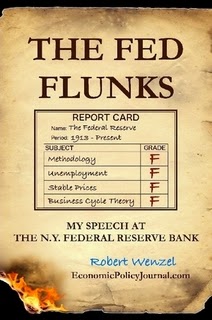
Robert Wenzel is Editor & Publisher of EconomicPolicyJournal.com and author of The Fed Flunks: My Speech at the New York Federal Reserve Bank.

Buy "The Fed Flunks" Now: